Organic electrode materials offer a route to sustainable energy storage that sidesteps the geopolitical and ecological costs of conventional lithium-ion chemistries. Catechol-bearing polymers are appealing cathode candidates because they pair high discharge potentials with fast redox kinetics and cycling stability. Prior catechol-containing polymers, though, were built from petrochemical feedstocks, and their electrochemical behavior has drawn far less study than their antioxidant and antimicrobial properties. A polypeptide platform made from bioderived catechol monomers could marry electrochemical performance with sustainability, while the adhesive character of catechol groups raised the prospect of building electrodes without a separate binder polymer.
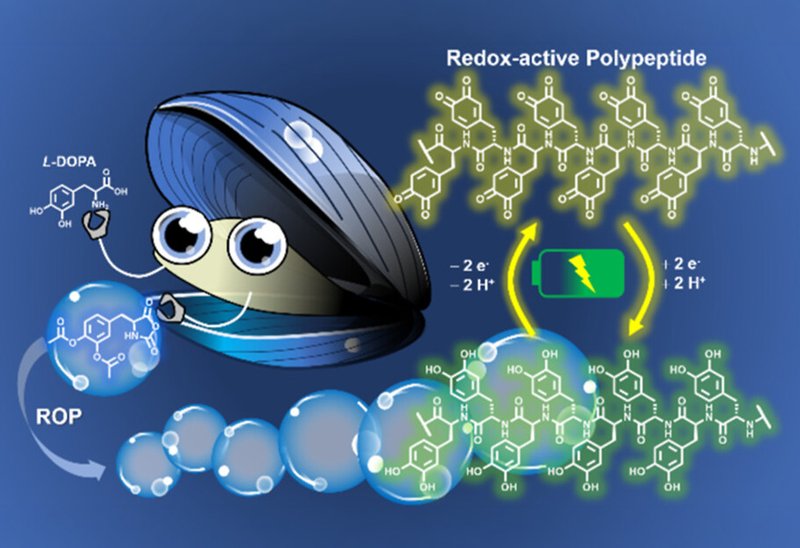
Researchers in the Wooley and Lutkenhaus Groups at Texas A&M University, published in Biomacromolecules, pursued two synthetic routes to catechol-functionalized polypeptides and tested them as solid-state composite electrodes. The first grafted dopamine onto a preformed poly(α-L-glutamic acid) backbone by postpolymerization amide coupling. When that route gave too little catechol and poor water solubility, the team switched to a monomer-first strategy: protecting the phenolic hydroxyls of L-DOPA as acetyl esters, converting the protected amino acid to its N-carboxyanhydride, polymerizing by ring-opening, then removing the protecting groups to expose free catechol at every repeat unit.
The postpolymerization route, using EDC·HCl and NHS coupling in water, reached an average dopamine incorporation of about 20% across repeated attempts, leaving catechol below 10% of total polymer mass. Both polymers gave weak voltammetric signals in solution, hampered by poor aqueous solubility. In the solid state, the L-DOPA homopolypeptide P(L-DOPA)50, carrying catechol at every repeat unit for roughly 65% of total mass, delivered a 7-fold higher peak current density than P(L-Glu)40-g-DA at matched mass loading and electrode composition. At 10 mV·s-1 it showed a quasi-reversible catechol/ortho-quinone couple with a half-wave potential near 0.29 V vs Ag/AgCl and a peak separation near 0.18 V, consistent with a concerted two-proton-coupled electron transfer in aqueous media. Peak currents scaled with the square root of scan rate, marking diffusion-limited behavior.
P(L-DOPA)50 also showed short-range molecular order by wide-angle X-ray scattering, attributed to π–π stacking among aromatic catechols and hydrogen bonding involving both side-chain catechols and backbone amides. Thermogravimetric analysis gave a 53% char yield at 500 °C, and microscale combustion calorimetry returned heat-release values the authors call competitive with reported biobased flame retardants. In assays with NIH/3T3 mouse fibroblasts, both polypeptides held viability near 80% at concentrations up to 100 μg/mL after 72 hours, above the 70% ISO 10993-5 cytocompatibility threshold, though the authors note that the polymers' limited aqueous solubility leaves the true cell exposure uncertain. Acidic degradation released L-DOPA among the products, pointing toward end-of-life monomer recovery, even as backbone hydrolysis stayed incomplete under the conditions tested.
The study sets out a design principle for bioderived, cathodically active polypeptides: building the redox unit into the monomer, rather than appending it afterward, gives the catechol density needed for useful electrochemical output. Because P(L-DOPA)50 is both electroactive and mussel-inspired in its adhesion, it opens a path to binder-free electrodes from a single bioderived polymer. Paired with flame-retardant character and cytocompatibility, the material points toward organic cathodes for wearable and implantable energy storage, where safety and biocompatibility come first.